YouTube Shorts Algorithm: How It Works in 2026
In this article
Shorts is not a smaller version of YouTube’s main algorithm. It operates on fundamentally different signals, different distribution mechanics, and different viewer behavior assumptions.
If you’re treating Shorts like short long-form content — optimizing for watch time percentage, keyword metadata, and publishing schedules — you’re optimizing for the wrong things. This guide breaks down how the Shorts algorithm actually works: what signals it uses, how initial distribution happens, and how the algorithm has shifted since Shorts monetization launched. Understanding this makes the tactics obvious.
How is the YouTube Shorts algorithm different from the long-form algorithm?
The YouTube Shorts algorithm is structurally closer to TikTok’s For You Page than to YouTube’s Browse or Suggested Videos. The key difference: long-form recommends based on viewer preferences and watch history. Shorts recommends based on real-time engagement signals from each individual Short, testing it on progressively larger batches of viewers.
Long-form YouTube uses a well-understood two-signal model: click-through rate (CTR) determines whether viewers try your video, and watch time determines whether they stay. The algorithm recommends videos that score well on both.
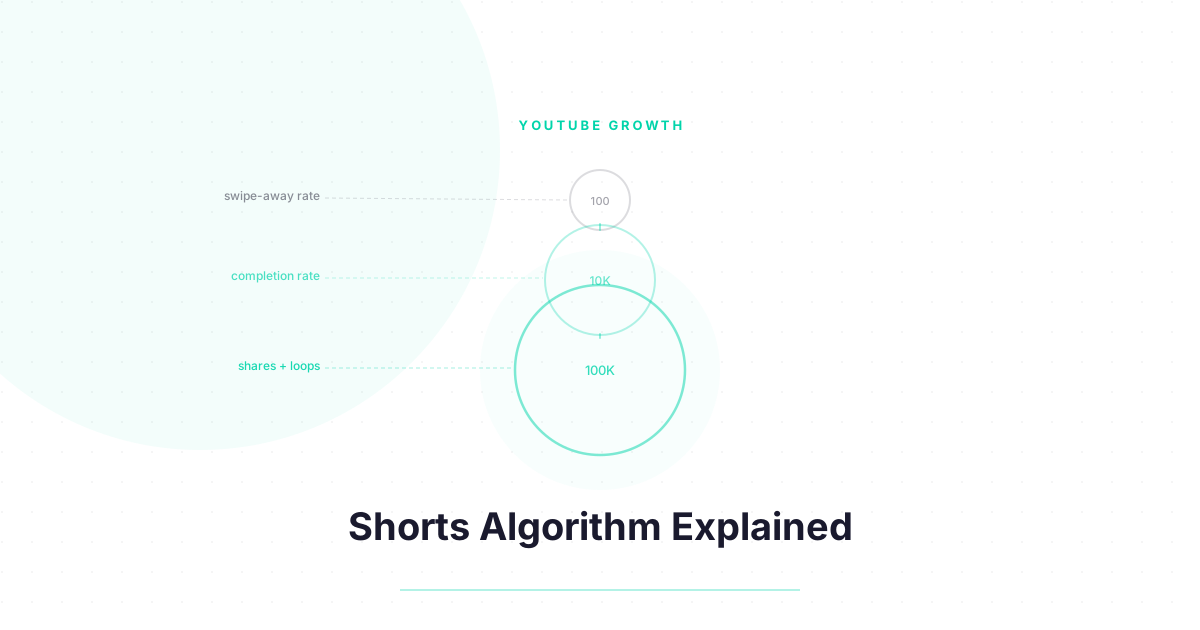
Shorts works differently. The recommendation engine doesn’t start with viewer preferences — it starts with the Short itself, then measures how each successive group of viewers responds to it. Think of it as A/B testing at scale: YouTube shows your Short to 100 viewers, measures engagement, shows it to 10,000 if engagement was strong, shows it to 100,000 if that also performed, and so on.
This means:
- Subscriber count matters less on Shorts than on long-form
- A new channel can go viral on Shorts without any algorithmic history
- But a video that fails its early test gets almost no second chances
What are the key signals the Shorts algorithm uses?
The Shorts algorithm uses swipe-away rate as its primary negative signal and completion rate plus loop rate as its primary positive signals. A Short with 80% completion but no likes still outperforms a Short with 50% completion and many likes. Behavioral signals always outweigh reaction signals in the Shorts system.
Here is how the Shorts algorithm signals stack up, from most to least impactful:
Negative signals (suppress distribution):
- Swipe-away rate — viewers immediately skipping past your Short
- Video report rate — viewers flagging content as inappropriate or spam
- Subscriber loss rate — subscribers lost after viewing your Short
Positive signals (expand distribution):
- Completion rate — viewers watching your Short to the end
- Loop rate — viewers who let the Short play again automatically
- Shares — the highest-weight positive signal; sharing indicates strong positive response
- Comments — especially questions or reactions that suggest real engagement
- Likes — positive but lower weight than behavioral signals
- Saves to playlist — a signal of intentional interest
Neutral or near-neutral signals:
- Subscriber count of the creator
- Time of posting
- Hashtag metadata (matters less than in 2022–2023)
- Video title and description keywords
See the YouTube Help Center for YouTube’s own documentation on Shorts recommendations.
How does initial Shorts distribution work?
When you publish a Short, YouTube distributes it to a small test group — typically a mix of your existing subscribers and viewers with a relevant watch history. If this group engages well (low swipe-away, high completion), YouTube expands distribution to progressively larger audiences. Failing the first test means limited reach, regardless of the Short’s quality.
Initial distribution is the most critical phase for any Short. The early test group is small — often a few hundred viewers — but their behavior determines the entire video’s trajectory.
The distribution phases for a typical Short:
Phase 1: Subscriber test (0–6 hours) Your Short is shown to a small sample of your existing subscribers. This tests baseline engagement with people who already know your channel. If swipe-away rate is high here, the Short rarely reaches Phase 2.
Phase 2: Interest-matched expansion (6–24 hours) If Phase 1 performs well, YouTube shows the Short to non-subscribers with watch histories similar to your subscribers. This is where most growth happens.
Phase 3: Broad distribution (24–72+ hours) Shorts that perform exceptionally in Phase 2 get broader distribution — shown to viewers YouTube classifies as potentially interested based on looser interest signals. This is where viral Shorts emerge.
Phase 4: Ongoing recommendation (weeks to months) Well-performing Shorts continue to surface in recommendation feeds long after publishing. Unlike long-form, Shorts don’t typically have a “long-tail search” benefit — their reach is primarily from recommendation, not search.
What role does watch history play in Shorts recommendations?
YouTube’s Shorts recommendation system uses viewer watch history to decide which Shorts to show each viewer in their feed. Viewers who frequently watch cooking Shorts will see more cooking Shorts. But unlike long-form, Shorts also introduces viewers to slightly adjacent content — a mechanism for discovery that long-form recommendations rarely provide.
Watch history creates the viewer’s Shorts “fingerprint” — a content preference model YouTube updates continuously. Every Short a viewer watches, completes, likes, or shares adjusts their fingerprint.
What this means for creators:
Niche consistency helps. If your Shorts are consistently about the same topic, YouTube’s model gets better at finding viewers who like your content. Inconsistent topic mixing across Shorts makes it harder for YouTube to find the right audience.
Adjacent topic Shorts can expand your reach. A channel about productivity that occasionally posts Shorts about morning routines may tap into the fitness/wellness audience — a related segment YouTube will test your content against.
Viewer quality affects future distribution. If your Short reaches viewers who don’t engage (wrong audience for your content), their poor behavior data reduces future distribution even if the Short itself is good. This is why targeting matters — getting broad low-quality distribution is worse than narrow high-quality distribution.
Why don’t Shorts always help your main channel’s long-form performance?
Shorts and long-form content have separate recommendation systems that rarely cross-pollinate. A viewer who finds you on Shorts is in a different content-consumption mode than one who searches YouTube. Shorts subscribers convert to long-form viewers at a 5–15% rate, far lower than subscribers who found you via search or homepage recommendations.
This is a frequently misunderstood relationship. Many creators start Shorts expecting them to accelerate their long-form growth. Sometimes they do. Often they don’t.
The disconnect happens because:
- Shorts viewers are in a passive, fast-scroll mode. Long-form requires deliberate time investment.
- The audiences attracted by Shorts content may not overlap with long-form content interests.
- YouTube’s algorithm treats Shorts and long-form as separate products — watching your Shorts doesn’t signal to the long-form algorithm that a viewer wants to see your long-form.
When Shorts DO help your main channel:
- When your Shorts explicitly tease and link to specific long-form videos
- When the Shorts topic is identical to the long-form topic (not a completely different format)
- When you build a habit with Shorts subscribers first, then introduce long-form later with a community post or pinned comment
When Shorts DON’T help your main channel:
- When the Shorts content is entertainment or trending content unrelated to your main niche
- When there’s no explicit bridge from the Short to the long-form (no verbal CTA, no pinned comment link)
- When you’re using Shorts purely for subscriber count without considering audience quality
How has the Shorts algorithm changed since monetization was introduced?
Since YouTube launched Shorts monetization in 2023, the algorithm has weighted engagement quality more heavily. Revenue-generating Shorts need to attract viewers who interact with ads, which means YouTube distributes Shorts to more targeted, less passive audiences. This raised the effective baseline for what “good engagement” looks like.
Before Shorts monetization, YouTube’s primary optimization for Shorts was retention and platform time. After monetization, a commercial layer was added: Shorts now need to attract viewers who are valuable to advertisers.
The practical changes:
Higher engagement bar. Shorts that would have been “good enough” for distribution in 2022 may not reach the same threshold in 2026. The benchmark moved up.
Content category matters more. Categories that attract higher-value viewers (finance, technology, business) have seen Shorts perform differently than entertainment categories. This mirrors what happened with long-form YouTube ad rates years ago.
Spam suppression improved. Post-monetization, YouTube significantly reduced the reach of repetitive, low-effort Shorts designed to game the algorithm. Templates, AI-generated content without added value, and slideshows are flagged more aggressively.
See the YouTube blog on Shorts monetization for YouTube’s own announcements on how Shorts revenue sharing works and the eligibility criteria.
Shorts Algorithm vs. Long-Form Algorithm: Signal Comparison
| Signal | Shorts Weight | Long-Form Weight | Notes |
|---|---|---|---|
| Swipe-away / bounce rate | Primary negative | Less critical | First 2 sec matters most in Shorts |
| Completion rate | Primary positive | Important | Full loop = stronger signal in Shorts |
| Loop rate | Primary positive | N/A | Shorts-exclusive signal |
| Click-through rate (CTR) | Low importance | Primary positive | Shorts don’t have thumbnails in feed |
| Watch time (minutes) | Low importance | Primary positive | Duration less relevant for 60-sec max |
| Shares | Very high weight | High weight | Top positive signal in both |
| Likes | Moderate weight | Moderate weight | Social signal in both |
| Subscriber history | Low weight | High weight | Shorts reaches non-subs more easily |
| Search keyword match | Very low | Very high | Long-form is discovery via search; Shorts rarely is |
| Trending audio use | Moderate | N/A | Shorts-specific distribution boost |
For tactical tips on applying this to your content, see How to Get More Views on YouTube Shorts and the YouTube growth hub.
Want the algorithm decoded as it changes? Subscribe to the newsletter — every Tuesday we cover platform algorithm updates you can act on immediately.
FAQ: YouTube Shorts Algorithm
Can a new channel with 0 subscribers go viral on Shorts? Yes. The Shorts algorithm doesn’t require an existing subscriber base. It distributes based on content performance, not channel history. Channels have gone from 0 to hundreds of thousands of views on their first Short when the content hit the right engagement signals.
Why does my Short stop getting views after 72 hours? Most Shorts peak in distribution within the first 72 hours. If a Short doesn’t pass the initial engagement tests, YouTube stops distributing it. Unlike long-form, Shorts rarely benefit from long-tail search traffic. A Short that doesn’t gain traction early usually stays flat.
Does the Shorts algorithm favor certain niches? Not officially, but in practice, niches with highly engaged fan communities (fitness, finance, gaming, beauty) tend to see stronger Shorts distribution. This is because viewers in these niches have strong watch history patterns that YouTube can match against.
Should I delete Shorts that perform badly? Generally no. Deleting Shorts removes them from your channel analytics and loses whatever engagement they did accumulate. A better approach: study what made them underperform and apply those lessons to future Shorts rather than starting clean.
Does posting frequency affect Shorts algorithm performance? Consistency helps build your watch history signal bank and trains YouTube’s content classification model for your channel. But posting daily bad Shorts is worse than posting three good ones per week. Quality of engagement always outweighs volume.
Keep Reading
What to Do Next
Choose the path that fits where you are right now.
Pick Your Niche
Download the free Instagram Algorithm Decoder. See the 6 signals Instagram uses to rank your content, their approximate weights, and a self-audit to score your last 10 posts.
Download FreeStart Building
Read the step-by-step setup guide for your platform.
Get Weekly Tactics
One tip, one tool, one case study. Every Tuesday.
Free. No spam. Unsubscribe anytime.