TikTok Algorithm Changed in 2026: Here Is What's Different
In this article
Your views dropped and you did not change anything. That is not in your head. TikTok’s recommendation algorithm has undergone meaningful shifts since mid-2024, and what worked before is not what works now. Here is a clear-eyed breakdown of what changed, what TikTok now prioritizes. According to TikTok’s official algorithm explanation, the platform has increasingly weighted shares and saves over passive watch time, and how to adapt without starting from scratch.
What Is the TikTok Recommendation Algorithm and How Has It Evolved?
The TikTok recommendation algorithm is a multi-signal ranking system that determines which videos appear on each user’s For You Page. TikTok has confirmed the system uses completion rate, shares, comments, and saves as primary signals — but the relative weights of these signals have shifted significantly since the platform’s 2024 and 2025 updates, with higher emphasis now placed on content that drives external sharing and saves.
The TikTok recommendation algorithm is a content distribution engine that predicts what each user wants to see before they know they want it. It learned from ByteDance’s earlier short-video product and has been refined continuously since TikTok’s Western launch.
In the early years (2019-2022), TikTok’s algorithm was relatively easy to game: strong audio, trending sounds, and high raw like counts could carry weak content. That era is over. What TikTok’s system rewards in 2026 looks meaningfully different.
What Did TikTok Actually Change in 2025 and 2026?
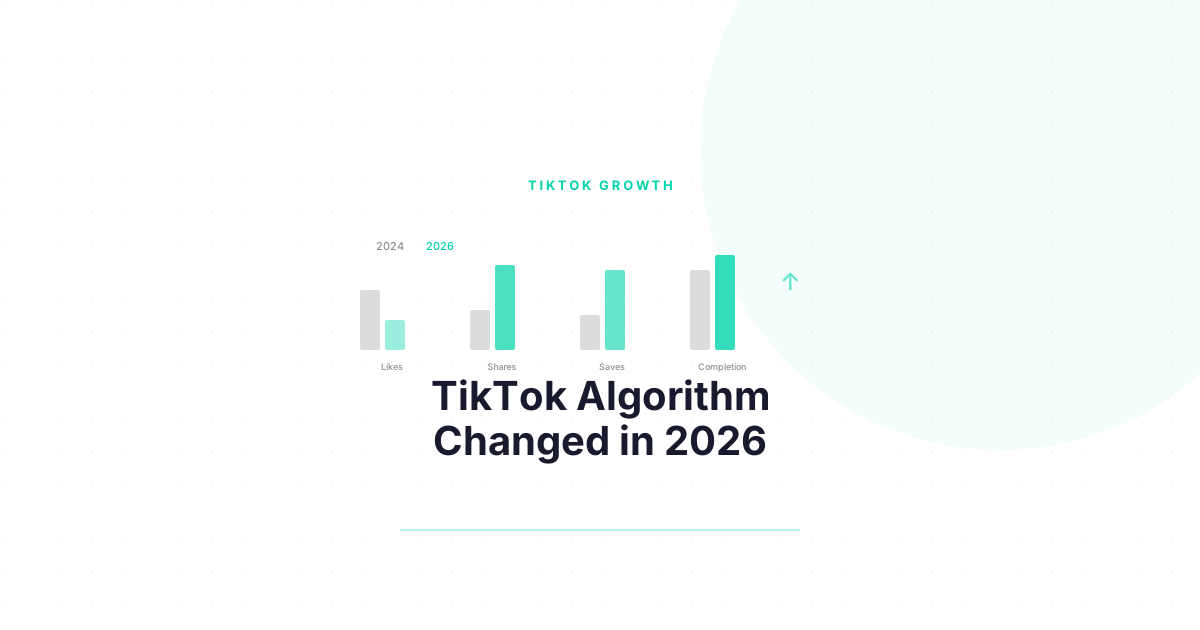
TikTok’s 2025 algorithm updates deprioritized like counts as a standalone signal and increased the weight given to shares, saves, and second-watch rate (rewatches). TikTok’s creator resources confirm the platform now places greater emphasis on content that drives “meaningful interaction” — which the system operationalizes as content users share externally and save for later, not just passively consume.
The platform did not publish a single “algorithm update” announcement. The changes emerged gradually through observed creator performance data and TikTok’s own creator education content. Here is what has verifiably shifted:
| Signal | Weight Pre-2025 | Weight 2026 | What Changed |
|---|---|---|---|
| Like count | High | Low-Medium | Became too easy to inflate; deprioritized |
| Completion rate | High | Very High | Still the primary signal; now even more decisive |
| Shares | Medium | Very High | External shares now a top-tier distribution signal |
| Saves | Medium | High | Saves indicate long-term value; algorithm rewards it |
| Comments | Medium | Medium-High | Quality of comments now a factor, not just count |
| Rewatches | Low | High | Second-watch rate added as a retention signal |
| Followers | Low | Very Low | Following count is nearly irrelevant to distribution |
The key insight: TikTok has moved from rewarding passive engagement (likes, views) to rewarding active engagement (shares, saves, comments, rewatches). Content that someone watches once and scrolls past is worth less than content they rewatch, save, or send to a friend.
Why Did TikTok Deprioritize Likes?
TikTok deprioritized raw like counts because likes became too easily inflated through like-for-like exchanges, purchased engagement, and creator communities coordinating likes. Shares and saves are harder to fake — they require a user to take an additional deliberate action that signals genuine value. TikTok’s goal is to surface content that real users find genuinely useful or entertaining, not content that games a single metric.
This shift was predictable. Every mature platform eventually moves away from its easiest-to-game signal. Instagram did it with follower counts. YouTube did it with raw view counts. TikTok’s response was to elevate shares and saves — behaviors that require genuine intent from the viewer.
The creator communities that were built around coordinated like exchanges saw their reach drop first. Then broader platform optimization for like-bait content (posts designed to provoke a double-tap) followed. If your content was built around getting likes, you felt this change acutely.
How Did the 2026 TikTok Updates Affect Creator Reach?
Creators who built their content strategy around high like counts or viral hooks without strong saves and shares saw the sharpest reach declines. Creators focused on educational or utility content — videos users save for reference — saw reach hold or increase. TikTok’s direction is toward content with demonstrated long-term value, not one-time entertainment spikes.
The creators who reported the biggest view drops in 2025-2026 had one thing in common: high like rates but low save and share rates. Their content was likeable — easy to double-tap — but not valuable enough to save or share.
Who saw growth:
- Tutorial creators whose content users save to rewatch later
- Niche educators whose videos are shared within specific communities
- Storytellers whose videos get rewatched because they missed something
- Product reviewers whose content gets shared as recommendations
Who saw drops:
- Trend-chasers whose content was timely but not durable
- Like-bait creators who optimized for the double-tap reflex
- Broad entertainment accounts with no specific reason to save or share
What Does TikTok’s Algorithm Now Prioritize in 2026?
In 2026, TikTok’s algorithm prioritizes content with high completion rate (above 80%), strong share rate, and meaningful saves. Secondary signals include comment quality (not just count), rewatch rate, and profile visits after watching. The algorithm also now factors in viewer-to-creator relationship strength — content shown to followers that performs well gets pushed to non-followers first.
The current signal hierarchy, from highest to lowest weight:
- Completion rate — finishing a video signals it was worth watching
- Share rate — sending to others signals the content has external value
- Save rate — saving for later signals durable utility
- Rewatch rate — rewatching signals something was missed or loved
- Comment engagement — substantive comments signal conversation-worthy content
- Profile visits — clicking to a profile after watching signals creator-level interest
- Follows from video — following after watching signals strong creator-viewer alignment
Likes are still tracked, but they are not in the top seven. That is a significant shift from three years ago.
Struggling to grow even after adapting to these changes? Download the free TikTok Algorithm Decoder — we map every current signal with approximate weights and tell you which ones to optimize first. Free.
How Should You Adapt Your Posting Strategy to the 2026 Algorithm?
To adapt to the 2026 TikTok algorithm, optimize for completion rate by front-loading your best content in the first two seconds and cutting any dead weight at the end. Build share triggers into your content — moments that make a viewer think “I need to send this to someone.” Add save triggers — checklists, tutorials, or reference content that viewers want to return to.
Practical changes to make now:
For completion rate:
- Cut your intros completely. Start at the point.
- Front-load the most interesting or surprising element
- End with a question or cliffhanger that makes rewatching feel worthwhile
- Keep total length to what the content actually requires — do not pad for time
For share rate:
- Create moments of surprise, validation, or humor that make someone think of a specific person
- Make opinions strong enough that people want to share to agree or disagree
- Create reference content (“the only X guide you need”) that people share as recommendations
For save rate:
- Build tutorial content with multiple distinct steps
- Create checklists, lists, or comparison content worth revisiting
- Add a “save this for later” call-to-action explicitly — it works, and TikTok’s own creator resources confirm it
For rewatch rate:
- Embed details that reward rewatching (“notice the background in this scene”)
- Use layered information — surface-level content plus a deeper point for careful viewers
- Structure reveals at the end that make the beginning more meaningful in retrospect
Does Posting Frequency Still Matter After the Algorithm Changed?
Posting frequency matters less in 2026 than posting quality. TikTok’s algorithm now distributes based on video-level performance signals, not account-level post volume. A single video with an 85% completion rate and strong shares will reach more people than ten videos with average metrics. Consistency matters for audience building, but volume alone no longer drives algorithmic reach.
This is a significant shift from TikTok’s early days when daily posting was a legitimate growth strategy. The platform has matured: it now rewards content quality over content quantity.
The practical recommendation: post as often as you can maintain quality. For most creators working alone, that is two to four times per week. Going from two to five posts per week will not meaningfully increase your reach if the three extra posts have mediocre performance metrics.
For more on growing your audience beyond TikTok, see the Audience Growth Hub.
Frequently Asked Questions
Did TikTok algorithm change in 2026?
Yes. TikTok’s algorithm has shifted meaningfully since 2024-2025. The platform deprioritized raw like counts and increased the weight given to shares, saves, and rewatch rate. Completion rate remains the top signal. Creators who built strategies around high like counts saw reach drops; creators optimizing for shares and saves saw relative stability or growth.
Why did my TikTok views suddenly drop?
The most common cause of sudden view drops is a change in content performance signals. If your like-to-view ratio dropped, if shares declined, or if your content shifted to a new topic without your audience following, the algorithm reduces distribution. Check your analytics for completion rate — if it is below 60%, your hooks need work. See the How to Fix Your TikTok Algorithm guide for a full diagnostic.
Does the TikTok algorithm still favor trending sounds?
Trending sounds still provide a modest boost — TikTok does surface content using popular audio in dedicated sound pages. But the boost is smaller than it was in 2020-2022. Completion rate, shares, and saves carry far more weight than sound choice. Use trending sounds when they fit naturally; do not chase them if they hurt your content quality.
How does TikTok decide which non-follower FYPs to show my content on?
TikTok uses a staged distribution model. A new video is first shown to a small test audience (often your followers and a small non-follower group). If that initial audience’s performance signals are strong (completion rate, shares), the video gets pushed to a larger non-follower pool. Strong performance at each stage triggers progressively larger distribution waves.
Does commenting on my own videos help after the algorithm change?
Commenting on your own videos to start conversation is a legitimate tactic, but it has minimal direct algorithmic impact. What matters is whether your comment prompts other users to reply — replies increase comment engagement signals. Pinning a question as your own comment is the most effective version of this approach.
Keep Reading
- How to Reset Your TikTok Algorithm — If your FYP is broken and you want to start fresh, this is the step-by-step guide
- How to Fix Your TikTok Algorithm When It Stops Working — Diagnostic guide for creators whose views dropped after the algorithm changes
- How to Change Your TikTok Algorithm to Show You Better Content — Active training tactics for shaping your FYP on an ongoing basis
What to Do Next
Choose the path that fits where you are right now.
Pick Your Niche
Download the free Instagram Algorithm Decoder. See the 6 signals Instagram uses to rank your content, their approximate weights, and a self-audit to score your last 10 posts.
Download FreeStart Building
Read the step-by-step setup guide for your platform.
Get Weekly Tactics
One tip, one tool, one case study. Every Tuesday.
Free. No spam. Unsubscribe anytime.