LinkedIn Content Strategy: What Actually Gets Reach in 2026
In this article
Most LinkedIn content strategies are too complicated. Here is one that works.
Creators overengineer their LinkedIn approach because LinkedIn looks like a serious platform that requires a serious strategy. The reality is simpler: two to five posts per week, three content types in rotation, and a clear understanding of which formats the algorithm rewards. The creators who grow fastest on LinkedIn in 2026 are not the ones with the most elaborate editorial calendars — they are the ones who have identified what works for their specific audience and repeat it systematically. This guide gives you that system.
What Is a LinkedIn Content Strategy?
A LinkedIn content strategy is a repeatable system for deciding what to post, how often to post, and in what format — designed to grow your professional audience and establish your authority in a niche. A working strategy in 2026 centers on 3 content types, 2–3 post formats, and a posting cadence of 3–5 times per week. Everything else is optimization.
Before building a content strategy, it helps to be clear on what you are optimizing for. LinkedIn content can serve different goals:
Follower growth: Reach people outside your existing network and convert them into followers. Authority building: Establish yourself as a credible voice in a specific niche so that the right people think of you when they have a problem you can solve. Lead generation: Convert content engagement into direct inquiries, email subscribers, or sales conversations.
These goals are related but not identical. A post that maximizes follower growth (high reach, broad appeal) may generate fewer leads than a post that speaks directly to your ideal client with a specific problem they recognize. Your strategy should reflect your primary goal — and that goal may shift as your account grows.
For most creators in the 0–10K follower range, follower growth is the priority. You need reach before you need conversion.
What Are the 4 LinkedIn Content Formats Ranked by Reach?
In 2026, LinkedIn format reach ranks as follows: carousels (highest), short text posts (high), short-form video (high), and image posts (medium). External link posts rank last — LinkedIn’s algorithm actively suppresses content that sends users off-platform. If you have one link to share, put it in the first comment rather than the post body.
This ranking is not arbitrary. Each format’s position reflects how much dwell time it generates and how the LinkedIn algorithm interprets that engagement.
| Format | Reach Level | Dwell Time | Best Use Case |
|---|---|---|---|
| Native PDF carousel | Highest | 45–90 seconds per post | Frameworks, lists, step-by-step guides |
| Short text post (under 200 words) | High | 15–30 seconds | Opinions, insights, lessons |
| Short-form video (native, under 90s) | High | 30–90 seconds | Process walkthroughs, personality-led content |
| Image post (single image) | Medium | 8–15 seconds | Data visualizations, quote cards |
| Long-form LinkedIn article | Low for feed | N/A in feed | SEO, evergreen reference content |
| Poll | Medium | Low | Audience research, light engagement |
| External link post | Lowest | Very low (click exits) | Avoid or use first-comment workaround |
Source: Format reach patterns reflect widely observed data from LinkedIn creator communities and analytics tools including Shield Analytics.
Two notes on this table:
Video is gaining ground. LinkedIn has been pushing its video tab and short-form video distribution since late 2025. By mid-2026, native video may challenge carousels for the top reach position. If you can create short-form video, start experimenting now. The trend is clear.
Text posts are underrated. A short text post — 100–200 words, one clear insight, no images — consistently generates strong comment rates relative to reach. Comments are a high-quality engagement signal. Many creators who default to carousels for reach find that text posts generate more meaningful conversation, which has its own value for authority building.
What Are the 3 Types of LinkedIn Content That Perform Best?
Three content types consistently outperform everything else on LinkedIn in 2026: insights from your work (specific, first-person, real), strong opinions backed by evidence (contrarian but not cynical), and frameworks or systems made visual (reusable mental models your audience will save). These work because they give viewers something they can immediately apply, forward, or return to — all of which are engagement signals the algorithm rewards.
Type 1: Insights from your work. This is the “here is what I learned from doing X” category. Not “here is what I read about X” — what you personally learned from doing it. Specific numbers, specific situations, specific outcomes. The most engaging version of this type includes a counterintuitive finding: something that surprised you, that contradicts conventional wisdom, or that reveals a gap between what people assume and what is actually true.
Examples:
- “I posted every day for 30 days on LinkedIn. Here is what the data actually showed.”
- “We ran the same carousel at 8am and 12pm for three weeks. Here are the impression numbers.”
- “My most-engaged post of 2026 had 47 words. My least-engaged post had 312. I now believe brevity is a skill.”
Type 2: Strong opinions backed by evidence. LinkedIn’s algorithm rewards content that generates real comments. Nothing generates comments faster than a well-reasoned, specific opinion that challenges a common assumption. This is not contrarianism for its own sake. It is taking a clear, defensible position on something your audience debates.
Examples:
- “Posting frequency matters less than posting quality on LinkedIn. Here is the data.”
- “The ‘consistency’ advice is mostly wrong. Here is what actually compounds.”
- “LinkedIn reach is not declining. Most creators are just posting the wrong format for 2026.”
Type 3: Frameworks and systems made visual. Reusable mental models — 2x2 matrices, three-step systems, decision trees — are the most saveable content type on LinkedIn. When someone saves your post, it tells the algorithm your content is worth distributing more widely. Frameworks are saved at 3–5x the rate of pure text posts.
Examples:
- A 2x2 matrix for deciding which content ideas to pursue
- A three-step system for turning a meeting into a LinkedIn post
- A decision tree for choosing between carousel and text post formats
For frameworks, the carousel format is usually the right vehicle — one visual element per slide, building to the complete framework on the final slide.
What Kills LinkedIn Reach?
Three content types consistently underperform and can damage your algorithmic reputation over time: overtly promotional posts, recycled Instagram captions, and humble-brag announcements. LinkedIn’s algorithm has become much better at identifying low-quality engagement bait, and accounts that post it regularly see their distribution decline even when individual posts generate reactions.
Overtly promotional posts. “Check out my new course! Link in bio!” — posts that are primarily sales pitches with no standalone value — get the lowest engagement rate of any content type. Not because the audience dislikes your product, but because the content gives them no reason to engage. Low engagement rate in wave 1 = no wave 2 distribution. Your promotional posts reach only the small percentage of your followers who see wave 1, which is the exact opposite of what you want when promoting something.
The fix: lead with the insight or problem your product solves. Make the post valuable as a standalone piece of content. Mention your product at the end as a related resource. This structure generates 3–5x more engagement than a direct pitch.
Recycled Instagram captions. Instagram copy does not port to LinkedIn. The voice is different, the audience is different, and the algorithm context is completely different. Instagram captions often use line breaks every two words for visual effect, reference Stories or Reels that do not exist on LinkedIn, use emoji-heavy formatting, and assume a general consumer audience. LinkedIn readers in your niche are professionals who will notice immediately that the content was not written for them.
Humble-brag announcements. “Humbled and grateful to announce that I have been selected for [thing]…” These posts generate a burst of congratulation reactions from your network, but almost no comments, no saves, and no shares. The engagement is low-quality, the algorithm sees through it, and the distribution stops after wave 1. If you have a genuine achievement to share, frame it around the lesson, the process, or the data — not the announcement itself.
What Is the Right LinkedIn Posting Frequency?
The posting sweet spot for LinkedIn in 2026 is 3–5 times per week. Below 3 times per week, the algorithm does not establish a strong enough pattern to compound your distribution. Above 5 times per week, content quality typically drops faster than the quantity benefit — the algorithm notices lower engagement rates on your more frequent, lower-quality posts and adjusts your baseline distribution down.
This is not a rule LinkedIn states explicitly. It is a pattern observed consistently across creator accounts. Here is the reasoning behind the range:
Why 3+ times per week: LinkedIn’s algorithm builds an engagement baseline for your account — an expected engagement rate based on your posting history. Regular posting, three or more times per week, gives the algorithm enough data to establish that baseline and route your posts to an appropriate initial audience size. Sporadic posting (once per week or less) means the algorithm has to re-establish your baseline with every post, which tends to result in smaller initial distribution.
Why 5 or fewer times per week: The quality threshold is real. Creators who post daily often start producing filler content — generic advice, recycled takes, posts that could have been written by anyone — because they run out of genuine insight at that cadence. The algorithm detects lower engagement rates on these lower-quality posts, which brings your overall account distribution baseline down. Three to five high-quality posts per week outperforms seven medium-quality posts per week, consistently.
Posting frequency guide:
| Cadence | Who It Works For | Risk |
|---|---|---|
| 1x/week | Creators with very high-value, time-intensive content | Slow compounding, algorithm baseline resets often |
| 2x/week | Sustainable for most solo creators | Below the threshold for strong compounding |
| 3x/week | Recommended baseline for most creators | Low risk, sustainable, good compounding |
| 4–5x/week | Creators with content systems or teams | Strong compounding; quality must hold |
| 6–7x/week | High-output creators with established audiences | Risk of quality drop and algorithm baseline damage |
Want to know how the LinkedIn algorithm actually scores your posts? The free Algorithm Decoder covers the signals in plain terms. Free.
How Do You Build a LinkedIn Content Calendar?
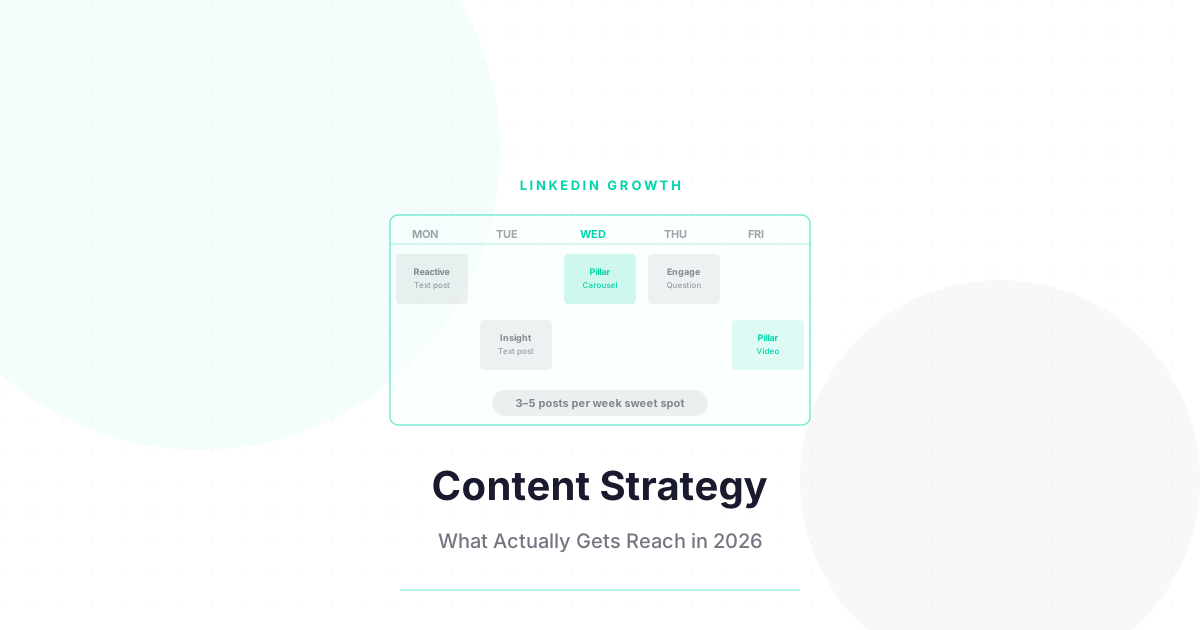
A LinkedIn content calendar works best when it balances three post types: pillar content (high-effort, high-value, usually a carousel — 1–2 per week), reactive content (fast response to something in your industry this week — 1–2 per week), and engagement content (a question, opinion, or observation designed for comments — 1 per week). This mix keeps your feed varied, maintains quality, and ensures you always have something to say.
Pillar content (1–2 per week). These are your highest-investment posts. A well-designed carousel, a thorough framework post, or a data-backed insight that took you time to compile. These are the posts that get saved, shared, and referenced. They build your authority over time. They take more effort to produce, so you cannot do them every day — but they do the heaviest lifting for your reach and follower growth.
Reactive content (1–2 per week). Something happened in your industry this week. A platform announced an algorithm change. A study came out. A creator said something controversial. Your take on that thing, published within 24–48 hours, is reactive content. These posts are fast to write (you do not need to research them heavily — they are your perspective), they feel timely and current, and they tend to generate comment discussions.
Engagement content (1 per week). A direct question to your audience. A poll. A “what do you think about X?” post. These generate comments, which are high-quality engagement signals. Use them sparingly — once a week at most — because they feel lightweight compared to pillar and reactive content, and overusing them can make your feed feel like it is gaming engagement rather than providing value.
Simple weekly template:
| Day | Content Type | Format | Time Investment |
|---|---|---|---|
| Monday | Reactive content | Short text post | 20–30 min |
| Wednesday | Pillar content | Carousel or detailed text post | 60–90 min |
| Thursday | Engagement content | Text post with question | 15–20 min |
| Friday | Pillar or reactive | Depends on the week | 30–60 min |
How Do You Repurpose Content for LinkedIn Without It Feeling Lazy?
Repurposing content for LinkedIn works when you extract the underlying insight and rewrite it natively, not when you copy-paste from another platform. A YouTube video can become a LinkedIn carousel (one key point per slide). A newsletter issue can become a text post (the single most important takeaway, 150 words). An Instagram carousel can become a LinkedIn carousel after a complete rewrite in a professional voice. The format can travel; the copy should not.
The fastest repurposing system:
From newsletter to LinkedIn text post: Take the most counterintuitive insight from your newsletter issue. Write it as a 100–150 word LinkedIn post with a clear point of view. Link to the newsletter in the first comment. This consistently outperforms writing original LinkedIn content from scratch because newsletters are already insight-dense.
From YouTube to LinkedIn carousel: Watch your own video. Write down the 7–10 most useful points. Each point becomes one carousel slide. Slide 1 is the video topic reframed as a LinkedIn promise. Final slide links to the video in the first comment. This repurposing path works well because video content is already structured as a logical sequence — which is exactly what a carousel needs.
From Twitter/X threads to LinkedIn text posts: Take your best-performing thread. Find the single strongest tweet. Expand it into a 150–200 word LinkedIn post with a full explanation of the point. The thread format does not translate to LinkedIn (sentence-per-line is cringe there), but the underlying insight does.
What does not work: direct copy-paste from any platform. LinkedIn readers can tell. The voice is different, the formatting is different, and they have often seen the original. Repurposing is rewriting, not re-posting.
For more on format specifics, see the LinkedIn Carousels guide and the Best Time to Post on LinkedIn timing guide.
Frequently Asked Questions
What kind of content gets the most views on LinkedIn? Native PDF carousels consistently generate the highest impressions per post for most creators in 2026, due to the dwell time advantage. Short text posts with a single strong opinion or insight are close behind and often generate more comments per impression. Short-form video is gaining ground and is worth experimenting with. Avoid external link posts — LinkedIn suppresses reach on content that sends users off-platform.
How often should I post on LinkedIn to grow? Three times per week is the recommended starting point. This is frequent enough for the algorithm to build a reliable distribution baseline, sustainable enough to maintain content quality, and manageable for most solo creators without a content team. Increase to 4–5 times per week only when you have a reliable content creation system that does not sacrifice quality.
Should I use hashtags on LinkedIn posts? 2–3 relevant hashtags are still beneficial in 2026, primarily for discovery in LinkedIn’s topic feeds. More than 5 hashtags looks spammy and provides no additional reach benefit. Choose specific hashtags that match your content and your Creator Topics. Do not use the same 3 hashtags on every post — vary them based on the specific topic of each post.
Does LinkedIn penalize promotional content? Not explicitly, but it deprioritizes it. Posts with no standalone value — pure promotional content with no insight or entertainment value — generate low engagement rates because viewers have no reason to interact. Low engagement in wave 1 means limited wave 2 distribution. The result is that promotional posts reach fewer people than quality content posts. Frame your promotional content around the value you provide, not the product you are selling.
How do I measure if my LinkedIn content strategy is working? Track these metrics weekly: impressions per post (overall reach trend), followers added per week (growth rate), comment rate (engagement quality), and save rate (content value signal). LinkedIn’s Creator Analytics (available with Creator Mode on) shows post-by-post impressions and follower trends. If impressions per post are rising over a 30-day period and you are gaining followers consistently, your strategy is working.
Keep Reading
- LinkedIn Carousels: How to Make Them and Why They Get Reach — the deep dive on the highest-reach format
- Best Time to Post on LinkedIn in 2026 — timing your posts for maximum first-wave engagement
- How to Grow LinkedIn Followers Without Being Cringe — the algorithm and format guide for follower acquisition
What to Do Next
Choose the path that fits where you are right now.
Pick Your Niche
Download the free Instagram Algorithm Decoder. See the 6 signals Instagram uses to rank your content, their approximate weights, and a self-audit to score your last 10 posts.
Download FreeStart Building
Read the step-by-step setup guide for your platform.
Get Weekly Tactics
One tip, one tool, one case study. Every Tuesday.
Free. No spam. Unsubscribe anytime.